Industrial date, expiry and lot coding machines
Select a coding machine for your packaging, installation point and variable data. Compare CIJ, TIJ and TTO for bottles, cartons and film, with example models to start a print trial.
Compare machines by packaging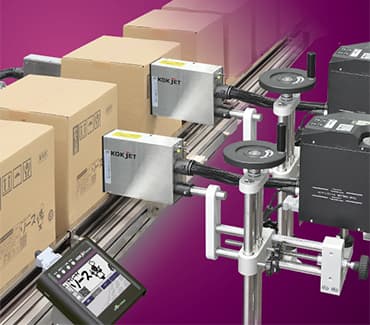
Match the machine to the material and print position
Check where the printhead can reach, the actual line speed and how soon the printed surface is handled.
Bottles and cans on a conveyor
Continuous inkjet (CIJ)
Consider CIJ for small characters on caps, bottle necks and curved moving surfaces. Test the throw distance, surface moisture and ink adhesion.
View CIJ printersCartons and flat surfaces
Thermal inkjet (TIJ)
Consider TIJ for clear text and codes where the head-to-surface distance can be held consistently. Test coated and uncoated cartons separately.
View TIJ printersPouches and film before forming
Thermal transfer overprinting (TTO)
Consider TTO when film passes through a print station on the packaging machine. Confirm that film motion, mounting space and ribbon fit the application.
View TTO printers
Example machines for print trials
- KGK JET CCS1000
A CIJ model for small characters and date codes. Trial it on the cap or neck with ink matched to the material.
- KGK JET HQ1100
A TIJ model for text and codes on surfaces with a controlled working distance, such as the side of a carton.
- TTO DC24A Series
An option for coding film and pouches. Check film motion and the installation point before selecting a model.
Prepare your date and lot data for a print trial
Expiry date format and changeover
Share the MFG and EXP formats, character size, line count and a sample pack. If dates must roll at a shift boundary or use an offset from manufacture, test the rules and model support. The manufacturer of the packaged goods determines the shelf life.
Lot numbers for traceability
Confirm whether an operator or production system supplies each code, and whether it changes at a new batch, line or shift. Test the longest lot code and verify the first unit after changeover. When an external system sends the data, check the model interface and test the actual message.
Check codes after normal handling
Print on production samples at operating speed and inspect legibility after handling, chilling or the next process step. Test any barcodes or QR codes with the scanners used on the line.
Discuss your coding application with Biz Nakhon
Share your packaging, print position, sample message and line speed to discuss machine selection and a print trial.